
3I/ATLAS — An Interstellar Messenger: Journey, Composition, and Why It Matters
In July 2025, astronomers confirmed the discovery of 3I/ATLAS (C/2025 N1) — only the third known interstellar object to pass through our Solar System, after 1I/‘Oumuamua (2017) and 2I/Borisov (2019). Unlike the countless comets that orbit our Sun, 3I/ATLAS is a true cosmic visitor, traveling on a hyperbolic path that proves it came from another star system and will never return. Its arrival offers scientists a rare opportunity to study the chemistry, structure, and motion of material formed far beyond our celestial neighborhood. Early observations already hint at surprising differences from typical Solar System comets, making 3I/ATLAS one of the most scientifically exciting discoveries of the decade.
Discovery:
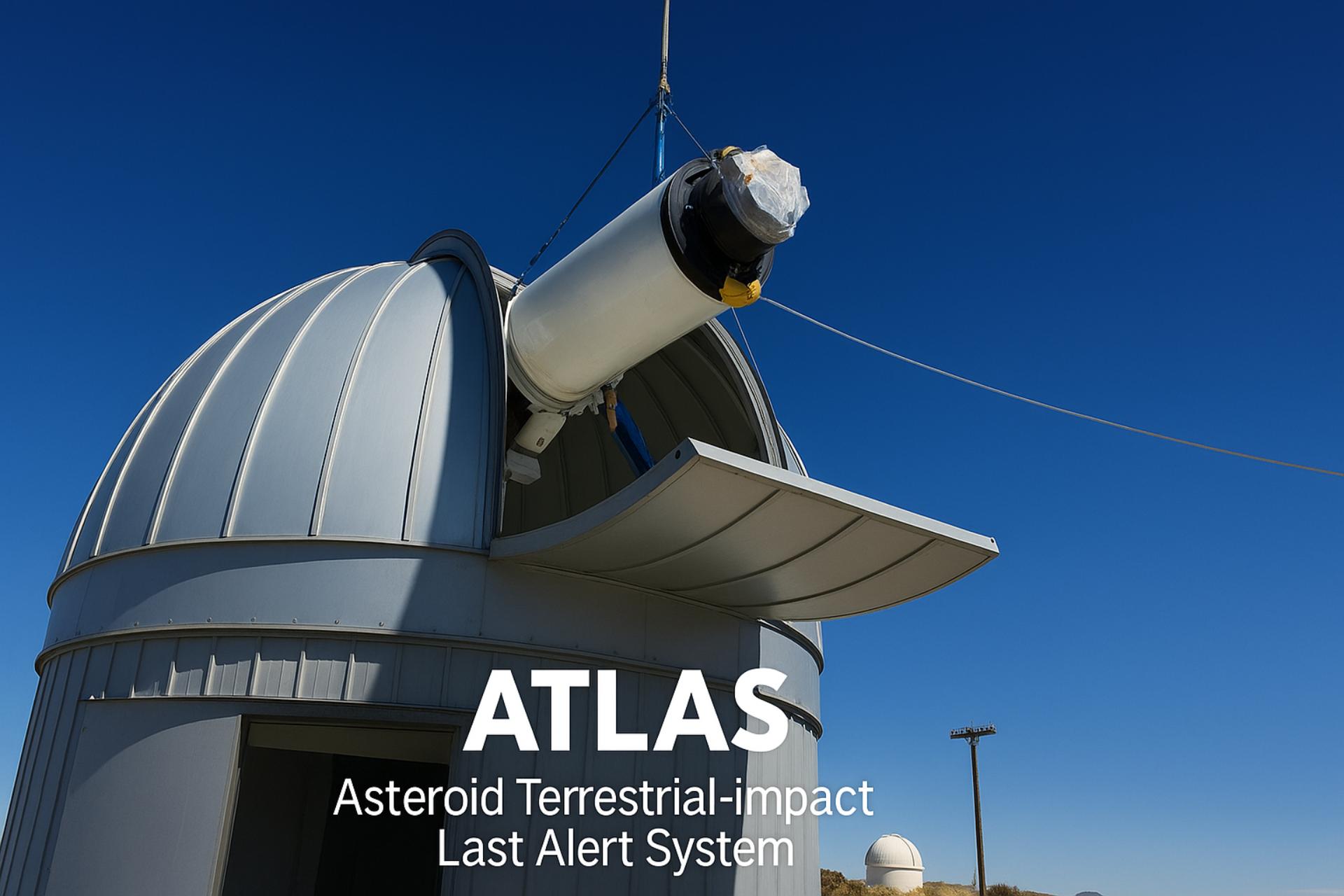
The story of 3I/ATLAS began on 1 July 2025, when astronomers using the Asteroid Terrestrial-impact Last Alert System (ATLAS) telescope in Chile detected a faint, comet-like object moving against the background stars. Initially logged under the designation C/2025 N1 (ATLAS), further observations revealed something extraordinary: the object was following a hyperbolic orbit, meaning it was not gravitationally bound to the Sun. This immediately identified it as an interstellar object (ISO) — only the third ever discovered, after 1I/ʻOumuamua (2017) and 2I/Borisov (2019).
After the discovery, astronomers combed through older space telescope data and made a breakthrough: they found that NASA’s Transiting Exoplanet Survey Satellite (TESS) had unintentionally captured 3I/ATLAS between early May and late June 2025. These precovery images showed the object before it was officially detected, allowing scientists to extend its observed path backward in time.
- By stacking multiple TESS exposures, researchers were able to spot the faint moving dot and measure its gradual brightening as it approached the inner Solar System.
- In the TESS passband, its brightness increased from about magnitude 20.9 to 19.6 over the span of several weeks.
- These extra data points greatly improved orbital calculations, confirming that the object’s eccentricity was about 6.2 — far too high for any Solar System comet.
Nature of 3I/ATLAS:
3I/ATLAS is not just another comet — it is a true interstellar visitor. Classified as both a comet and an interstellar object (ISO), it carries the signatures of icy activity while following a trajectory that proves it originated beyond our Solar System.
Unlike the first ISO, 1I/ʻOumuamua, which showed no obvious coma or tail, 3I/ATLAS has already displayed active outgassing. Observations from telescopes such as Hubble and Gemini South revealed a fuzzy coma and a developing tail, both created by gas and dust escaping as sunlight warms its surface.
Orbit & Trajectory of 3I/ATLAS:
The path of 3I/ATLAS (C/2025 N1) is unlike that of any comet born in our Solar System. Its orbit is not elliptical or parabolic but strongly hyperbolic, which means it is just passing through the Solar System once before escaping forever into interstellar space.
Activity of 3I/ATLAS:
Unlike 1I/ʻOumuamua, which showed no cometary activity, 3I/ATLAS is a fully active comet, displaying gas and dust emissions as it warms while approaching the Sun. Its activity provides astronomers with an unprecedented opportunity to study interstellar material in action.
- Scientific Significance:
- Offers clues about the composition of extrasolar planetary systems.
- Differs chemically from Solar System comets, suggesting diverse origins.
- Helps test theories of comet formation in different galactic environments.
- Comparisons:
- Third interstellar visitor, after ‘Oumuamua (2017) and Borisov (2019).
- More active than ‘Oumuamua and larger/brighter than Borisov.
- Observations & Missions:
- Several spacecraft (Psyche, Mars orbiters, JUICE, Europa Clipper, Lucy, Hera) may capture unique data.
- Especially important during perihelion when Earth telescopes cannot observe it.
- Origin:
- Likely ejected from another star system billions of years ago.
- May have originated in the Milky Way’s thick disk or thin disk.
Close Approaches:
- 3 October 2025: Mars Flyby
- 3I/ATLAS will pass within ~30 million km of Mars. While this is not a close pass by comet standards, it places the object within range of Mars orbiters (like Mars Express and TGO) and possibly rovers to attempt remote observations.
- 30 October 2025: Perihelion (closest to the Sun)
- The comet will reach its closest point to the Sun at about 1.4 AU (just inside Mars’ orbit).
- Unfortunately, from Earth’s perspective, it will lie nearly behind the Sun (solar elongation only ~12°), making it essentially unobservable from ground-based telescopes at this critical time.
Planet Encounters:
- 3 November 2025: Venus Pass
- On its outbound leg, the comet will pass ~0.65 AU from Venus. While still far, this proximity adds another planetary marker to its journey.
Closest to Earth:
- Early December 2025: Emerges from Solar Conjunction
- After weeks hidden by the Sun’s glare, 3I/ATLAS will reappear in Earth’s skies. It will likely be visible in the pre-dawn sky, enabling new telescopic studies.
- 19 December 2025: Closest Approach to Earth
- The comet will pass at a distance of about 1.8 AU from Earth. Although not a close encounter in planetary terms, this is the best chance for astronomers on Earth to gather high-quality data as it begins to fade outward.
Jupiter Encounter:
- 16 March 2026: Near Jupiter
- On its way out of the Solar System, 3I/ATLAS will pass ~0.36 AU from Jupiter. This giant planet encounter won’t capture the comet but provides another important checkpoint for orbital refinement.
Beyond – Departure:
- After March 2026, 3I/ATLAS will continue to fade as it speeds outward on its hyperbolic path.
- It will never return to the Solar System, instead resuming its interstellar voyage through the Milky Way.