
OI-1452 b: The Mysterious Ocean World 100 Light-Years Away
OI-1452 b: The Mysterious Ocean World 100 Light-Years Away
For decades, scientists have scanned the skies in search of distant planets that might resemble Earth — a place where water flows, where life might exist, where the secrets of the cosmos could be hiding. In 2022, they found one of their most intriguing candidates yet: TOI-1452 b, a super-Earth orbiting a red dwarf star nearly 100 light-years away in the Draco constellation.
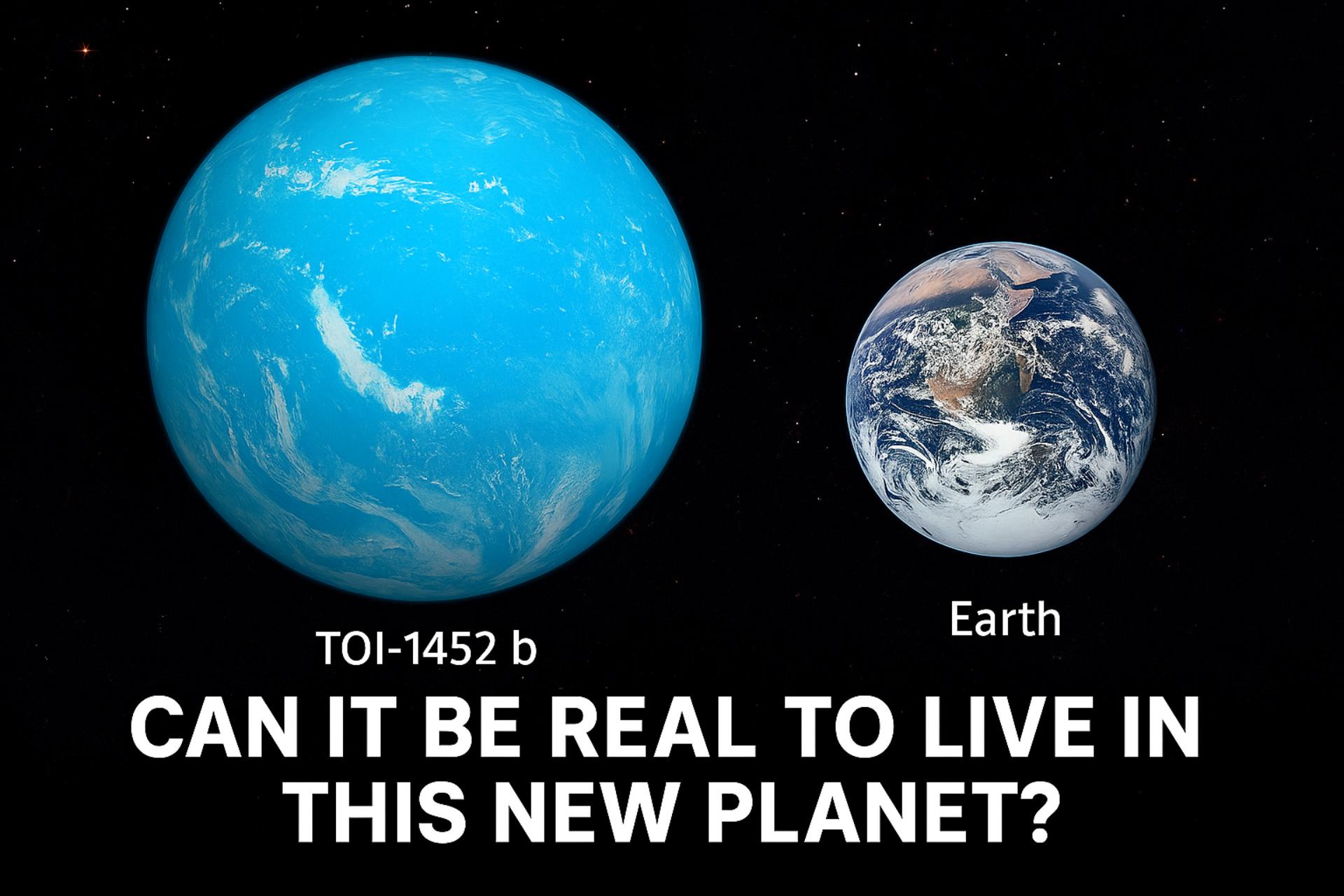
At first glance, TOI-1452 b may seem like just another distant exoplanet among thousands. But what makes this one special is something truly astonishing — it might be a "water world," covered in a deep global ocean, unlike anything we've seen before.
A Silent Revolution in the Sky
Discovered by NASA’s Transiting Exoplanet Survey Satellite (TESS) and confirmed by astronomers in Canada using the Observatoire du Mont-Mégantic, TOI-1452 b wasn’t found by accident. Its host star dimmed slightly every 11 days — a whisper from across the galaxy — and that was the first clue.
As scientists began measuring the planet’s mass and radius, something strange emerged. The numbers didn’t add up for a typical rocky planet. TOI-1452 b was too light for its size — and that led to a bold hypothesis: up to 30% of its mass might be water.
To put that into perspective, Earth’s oceans make up only 0.02% of its total mass.
This means TOI-1452 b could have oceans hundreds, maybe even thousands of kilometers deep — dark, vast, and alien. Its entire surface could be liquid. No continents. No land. Just endless, deep-blue waves under a faint red sun.
A Planet in the Goldilocks Zone
Despite orbiting incredibly close to its star — one full year on TOI-1452 b lasts just 11 Earth days — the planet lies within the so-called “habitable zone.” This is the sweet spot where temperatures are just right for liquid water to exist, thanks to the low energy output of its red-dwarf star.
And where there is water, there is always the possibility — however remote — of life.
This alien world is now a top candidate for future research with the James Webb Space Telescope (JWST). Scientists hope to analyze the planet’s atmosphere (if it has one) to look for signs of water vapor, greenhouse gases, or even the faint chemical traces of biology.
It’s a slow process, but the promise is enormous. TOI-1452 b might not be Earth 2.0 — but it might be something even more fascinating: a new kind of planet altogether.
As we peer deeper into the universe, planets like TOI-1452 b remind us that Earth is not the only watery world. Oceans, clouds, storms — even life — might not be unique to our pale blue dot. They may be out there, waiting, just beneath the surface of distant stars.